
In the second half of the 1990s, Timothy Snyder began to focus more intensively on Belarus. For his study The Reconstruction of Nations (2003), he examined the four-hundred-year history of nation-building in Poland, Ukraine, Lithuania, and Belarus. In his international bestseller Bloodlands (2010), the US-historian focused on Belarus as a region marked by Nazi and Stalinist terror. Since 2020, he has regularly addressed the history of Belarus and the Lukashenko regime in lectures and essays.
This is part of our special: Warum ist Belarus so unsichtbar?
To begin, of course, it’s not invisible to me. I’m a historian of Eastern Europe, in particular of the lands of the old Polish-Lithuanian Commonwealth, of which Belarus was central. It was the territorial heartland of the Grand Duchy of Lithuania, and it is very important to the history of many centuries of Central Europe. So, Belarus is not invisible to me.
I’m also asked how I came upon it. For that reason, I’ll begin with my own intellectual trajectory. I started as a historian of Poland. I was interested in understanding Polish history beyond the anodyne clichés of twentieth-century Central Europe. That moved me toward conflicts over Vilnius and conflicts over Galicia. It led me into understanding interwar Poland and, from there, the Commonwealth.
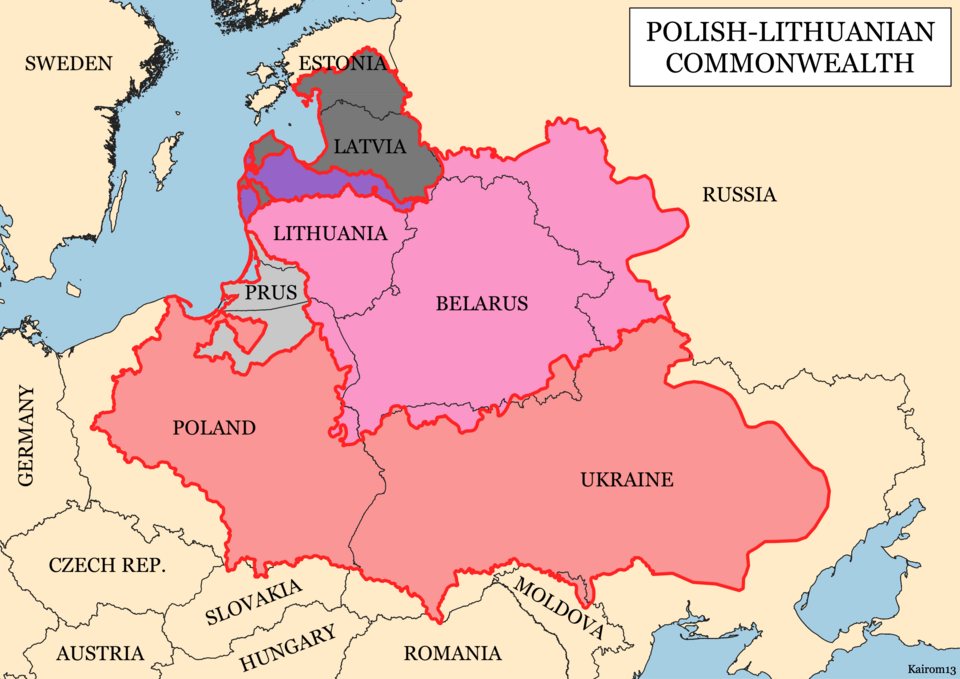
The Commonwealth has its own dignity, its own center, and its own rules of engagement, which leads one directly toward Belarus. As I tried to understand how that old Commonwealth became a set of new nations, I made sure to pay attention, in addition to the Jews, Germans, and Russians, to the four traditions that emerged directly as national traditions from the old Commonwealth: Lithuania, Belarus, Poland, and Ukraine. Although these nations have individual differences, they share a structural similarity. All four of those modern nations had, in some way, to do away with, to overcome the common tradition they once shared. To answer the main question of why Belarus is so invisible, I will point to four historical moments.
Belarus in Prehistory and Early History and in the Commonwealth
The first is our general West European trajectory of history. When we think about the past, we tend to follow a familiar line: Mesopotamia, Greece, Rome, the Renaissance, and then the exploration of the world. We tend overlook the lands of Eastern Europe, including Poland, Ukraine, the Baltic states, and perhaps above all Belarus, despite their participation extremely serious and meaningful parts of European history.
The lands of Belarus played significant roles in very early European history, including prehistory. They were part of processes such as Viking-era globalization, the development of distinctive forms of Eastern European Christianity, and the encounters between pastoral and nomadic peoples with settled agricultural peoples. My first point, then, is that although the lands of Belarus are extremely important to European history, they are often written out of the standard historical narrative.
If you’re Polish, you tend to think of the partitions as a very bad thing. Yet, paradoxically, there was one respect in which partition proved beneficial for the development of Polish national culture. After the end of the Polish-Lithuanian Commonwealth, Poland was divided among three powers for roughly 123 years: a German power, an Austrian power, and the Russian Empire. This meant that there was no Poland, but it also meant that one region was generally less illiberal than the others. It was always possible to maintain some degree of communication and exchange.
The same was true of Ukraine. Ukraine was divided between the Russian Empire and the Habsburg Monarchy. It was terrible that it was partitioned, but it also meant that the Galician portion — the Austrian-controlled part — was significantly more liberal for about forty years than the Russian-controlled part. As a result energies from the Russian part could be transferred the Austrian part and develop as necessary Ukrainian national ideas there.
Belarus, unlike Poland and Ukraine, lay entirely within the Russian Empire. This meant there was far less opportunity for the kind of cross-fertilization among different imperial policies and experiences. That hurt the development of Belarusian national cause and associated Belarus more closely with Russia.
Nowhere was the death rate higher. Nowhere were more villages destroyed. Nowhere were cities more devastated than in Belarus.
A third point worth noting is the impact of the Great Terror within the Soviet Union. During the 1920s and 1930s, the lands of contemporary Belarus were divided between Poland and the Soviet Union. On the Polish side, although there was no totalitarianism comparable to that of the Soviet Union, the Polish authorities nevertheless closed Belarusian schools and were generally hostile to Belarusian national culture.
Meanwhile, on the Soviet side, there was a temporary cultivation of Belarusian national revival during the 1920s. In the 1930s, however, there was a murderous attack on that very national revival. The repression was so extensive that it became very difficult to speak of a Belarusian national intelligentsia or national culture thereafter. This tragedy was compounded by the German invasion of the Soviet Union. Belarus became the absolute center of death and destruction in Europe during the Second World War. Nowhere was the death rate higher. Nowhere were more villages destroyed. Nowhere were cities more devastated than in Belarus.
This devastation resulted from the Holocaust of European Jews, from so-called anti-partisan operations, and from the fact that Belarus was the line between Germany, its occupied territories and Moscow. The combination of Stalinist terror followed by Nazi terror destroyed much of the Belarusian intelligentsia and decimated the country to a degree that no other European country was. After the Second World War, people from across the Soviet Union came to Belarus. That was not, in itself, a bad thing. But it did make it harder for Belarusian national culture to reassemble and develop in these conditions. A new society had to be built on the basis of shared post-1945 experiences, and indeed that did happen.
Belarus is an invitation to understand European and world history in its ancient, modern, and contemporary dimensions.
This leads me to the final point.
One reason Belarus has remained invisible is that when Belarusians had the opportunity to resist an anti-democratic and authoritarian regime, they did so by playing according to democratic rules. They protested peacefully. They sought international support. Unfortunately, they did so at a moment when authoritarian regimes had learned that they could ruthlessly use violence and propaganda. They also confronted a historical conjuncture in which Russia was looking for an excuse to dominate Belarus more directly, an opportunity that Alexander Lukashenko gave them.
This is another reason Belarus has become invisible. Its democratic movement, which was so recent and so inspiring, was transformed, with the help of fascist Russia, into a silence. Belarus, under what is essentially a form of joint dictatorial control, became one of the launching grounds for the invasion of Ukraine. That development also contributes to Belarus’s invisibility. Why think of a country as distinct when it is treated by a larger power merely as a site from which to launch an invasion?
These are some of the reasons why Belarus appears invisible. But once we understand them, we also see why Belarus is interesting. Belarus is an invitation to understand European and world history in its ancient, modern, and contemporary dimensions. It also gives us reason to think that Belarus may soon become visible again.
