

Ukrainians have fought and died for their country’s independence. They are doing so today, on the front lines or under Russian airstrikes behind them. For over a decade, they have been doing so in the underground resistance in annexed or occupied territories and in battles with Russian-supported separatists. In earlier eras, they died in famines exacerbated by Moscow, from KGB bullets and in Soviet labour camps. In the 20th century, Ukrainian nationalists fought against Russia but also – sometimes alongside German National Socialists – against Jewish and Polish communities in their own country. Before that, though, there were also those who envisioned a Soviet Ukraine that was independent – whether in a civic-nation model or a federal model.
This pursuit of state sovereignty at all costs: where does it come from? How has the Ukrainian concept of statehood changed over time?
Ukrainian historian Andrii Portnov outlines the historical development of ideas and practices of an independent Ukraine over the past two centuries up to the present day.
Chapters
There was no country by the name of Ukraine to be found on the political map of Europe at the start of the 19th century. The Russian Empire had destroyed the last elements of the Cossack Hetmanate in the late 18th century. However, the absence of a state structure should not be equated with the absence of a nationalist movement.
Inspired by the ideas of Herder and other Romantic philosophers, the Ukrainian intelligentsia proposed a project aimed at the cultural and political emancipation of the Ukrainian-speaking rural population of both existing empires, tsarist Russia and the Austro-Hungarian empire.
Drahomanov: Stateless Ukraine predestined for “ideal federalism”
One of the key figures of Ukrainian political thought in the 19th century was Mykhailo Drahomanov, an ancient historian who was forced to emigrate from the Russian Empire in 1876 due to his political beliefs. In exile, Drahomanov published the journal Hromada (Eng: Community) in Geneva and, in 1889, became the head of the world history programme at the University of Sofia.
In Drahomanov’s view, Ukraine, having, for historical reasons, neither an upper class nor its own state, was ideally suited for the socialist “practices of the stateless order”. And Ukrainians, he felt – “the most numerous of the peasant nationalities of Eastern Europe” – should play a key role in making an ideal federalism a reality. The “ideal”, here, consisted in the enjoyment of equal rights by all nationalities.
Drahomanov called on both the Polish and the Russian socialist movements to recognise the ethnocultural independence of Ukrainians and renounce any imperialist ambitions.
For Drahomanov, Ukrainian statehood was not the paramount aim. On the contrary, he argued that national unity within one state did not necessarily lead to greater freedom, using Germany as his example. He also called on both the Polish and the Russian socialist movements to recognise the ethnocultural independence of Ukrainians and renounce any imperialist ambitions.
Baсhynsky: The nation-state as necessary stage in the socialist revolution
The first theoretical justification for the political independence of Ukraine appeared in 1895, from the pen of the Lviv-based Marxist Yulian Bachynsky. In his essay Ukraina Irredenta, Baсhynsky attempted to apply Friedrich Engel’s analysis of the class character of the state to the Ukrainian context.
Baсhynsky compared the Ukrainian question to the Irish question, concluding that “Ukraine’s political independence is a sine qua non for its economic and cultural development, a condition for the very possibility of its existence.”1 This political independence would apply to “everyone who lives in Ukraine”, regardless of ethnicity or religion.
According to Bachynsky political independence would apply to “everyone who lives in Ukraine”, regardless of ethnicity or religion.
Taking a cue from Engels, Bachynsky pointed out that the nation-state was a necessary stage of societal development and an inevitable product of capitalist conditions. Accordingly, he considered Ukrainian political independence to be a necessary precondition for the formation of a Ukrainian bourgeoisie and hence for the accelerated creation of conditions intensifying the class struggle and the socialist revolution.
Lypynsky: A nation of citizens
The overthrow of the monarchy and the democratic February Revolution in 1917 in Russia created an opportunity for the Ukrainian intelligentsia to implement the ideals of socialism, federation and the right to national self-determination. The Ukrainian People’s Republic, proclaimed in Kyiv, had not yet survived for a year when it fell to the military aggression of the Russian Bolsheviks. Starting in 1918, Ukraine experienced a kaleidoscope of regime changes, foreign (German, Polish, French) intervention, peasant uprisings, and anti-Jewish pogroms. With the signing of the Treaty of Riga in March 1921, a new Polish–Soviet border was established: the Ukrainian provinces of the former Russian Empire (with the exception of Volhynia) were recognised as part of Soviet Ukraine under Bolshevik rule, while the western Ukrainian territories that had previously belonged to the Austrian Empire were ceded to the Polish Republic, which had been reestablished in 1918.
For Lypynsky, “all inhabitants of this country and all citizens of this state” were members of the Ukrainian nation.
The defeat of the Ukrainian Revolution, in which socialist and federalist rhetoric had played a prominent role, led to a painful reassessment of the tasks and methods of the Ukrainian movement. Viacheslav Lypynksy, a Christian-conservative thinker, proposed some original approaches in this context. Lypynsky, who had been shocked by the experiences in the revolutionary years 1917-1921, categorically rejected both democracy and socialism. But national exceptionalism and chauvinism had no place in his vision for the future of Ukraine either: for Lypynsky, “all inhabitants of this country and all citizens of this state” were members of the Ukrainian nation.
Lypynsky, himself born into a Polish noble family, emphasized that “anyone who wants the Ukraine to no longer be a colony is a Ukrainian” – i.e. anyone who advocated the establishment of a Ukrainian state. Lypynsky’s fundamentally integrative approach strongly influenced the further development of Ukrainian political thought.
The Crimean Archipelago
A Multimedia Dossier
Dontsov, Bandera & the Second World War: Radicalisation in the struggle for Ukrainian statehood
However, Lypynsky’s influence proved unable to match that of another political theorist in the interwar years of the 1920s and 1930s: Dmytro Dontsov, a zealous advocate of national exclusivity and the ruthless struggle for independent statehood in his book Nationalism2, which was published in Lviv in 1926.
The constant in Dontsov’s work is a radical anti-Russian attitude. His writings are rife with militant antisemitism and racism, and the influence of German National Socialism is palpable. Dontsov’s central theses match the rhetoric of the Organisation of Ukrainian Nationalists, which was established in1929 with the declared aim of fighting for Ukrainian sovereignty. Rejecting the methods of legal democratic politics on principle, the OUN operated in the underground, concentrating on young people.
The young nationalists saw inter-ethnic relations as a destructive struggle for existence in the social Darwinist sense. Rejecting any notion of the rule of law, the OUN wanted the borders established after the First World War to be redrawn and hence sought contact with Germany, which also had a direct interest in shifting state boundaries. With an eye to Mussolini’s Italy and Hitler Germany, the OUN advocated a single party dictatorship and the Führerprinzip (“leader principle”). In 1940, the organisation split into two fractions, each taking its name from its leader: the Banderivtsi (OUN-B, for Stepan Bandera) and the Melnykivtsi (OUN-M, for Andrii Melnyk).
The constant in Dontsov’s work is a radical anti-Russian attitude.
The German invasion of the Soviet Union began on 22 June 1941, and the Wehrmacht marched into Lviv on 30 June. The same day, the OUN-B declared the “restoration of the Ukrainian state” in that city. As this was done without the permission of the German authorities, Bandera (in Kraków at the time) and Yaroslav Stetsko, his second-in-command, were arrested and interned in a special barrack in the Sachsenhausen concentration camp (where they continued to be held until September 1944).
The complicity of some Ukrainian nationalists in the Nazi holocaust and the ethnic cleansing of the Polish population in Volhynia that the Ukrainian Insurgent Army (UPA) initiated are the darkest pages in the history of the Ukrainian underground.
The OUN’s authoritarian methods drew criticism from Ukrainian émigré thinkers early in post-war years. In particular, the philosopher Vasyl Rudko described the casual sacrifice of human lives for the sake of the abstract slogan of a people’s revolution as being characteristic of the OUN and argued that Dontsov’s ideology had paved the way for totalitarianism and a cult of violence. The historian Borys Krupnytsky also wrote of the dangers of modern national socialism in the late 1940s.
Khvylovy: “Independent republican organism as part of the Soviet Union”?
The Second World War led to the transfer of the western Ukrainian territories that had belonged to Poland until 1939 to Soviet Ukraine. In other words, it was Stalin – the politician responsible for the Holodomor of 1932–33 and mass repression – who realised the age-old aim of the Ukrainian movement: the unification of all Ukrainian territories within a single state.
The state in question – the Soviet Union – had been established in 1922, with Soviet Ukraine as one of its founding republics. Although they had installed Soviet rule in Ukraine through force of arms, the Bolsheviks recognised the mobilisation potential inherent in the Ukrainian national movement, the Ukrainian language and Ukrainian nationality. In the 1920s, Soviet Ukraine appeared to be the desirable form of Ukrainian statehood in the eyes of many people.
“Ukraine is independent not because we Communists desire it to be, but because the iron and irresistible will of the laws of history demands it …”
Mykola Khvylovy
The writer Mykola Khvylovy, for instance, wrote the following in his 1926 pamphlet Ukraine or Malorossia? (Malorossia or Little Russia was a pejorative name used by Great Russia (Russia itself) to define the territory of Ukraine as smaller and less powerful – dekoder): “We are indeed an independent state, one whose republican organism is part of the Soviet Union. And Ukraine is independent not because we Communists desire it to be, but because the iron and irresistible will of the laws of history demands it, because only in this way can we hasten class differentiation in Ukraine.”
By the end of the decade though, the Soviet government had already prohibited the expression of such views, most of Ukraine’s cultural elites had become the targets of repression and a programme of Russification was implemented in the education system, including measures aimed at bringing the Ukrainian language closer to Russian. Although these trends intensified over time, the Soviet Union never abolished Ukraine’s status as a republic, nor did it eradicate the independence of the Ukrainian language and nationality.
Presidential elections in Ukraine, 2019
rounds, regions, results
Since 1991: Democratic independence and the Soviet legacy
In 1991, the Soviet Union collapsed along the borders of 15 Soviet republics. In Ukraine’s case, the deliberate decision of the local elites of the Communist Party of Ukraine (CPU) to separate from Moscow and seek an independent existence played a key role in this. In 1992, Deutsche Bank published a report3 assessing Ukraine as one of the former Soviet republics with the best conditions for economic growth and political and social development, due to its industrialisation, the high level of education of its population and its natural resources.
The high economic expectations combined with the deep disappointment in the planned economy in the late Soviet period as well as the noticeable shortages of many goods go a long way towards explaining the striking results of the referendum on Ukrainian independence that was held on 1 December 1991: 92.3 of voters cast their ballots in favour of independence, with a voter turnout of 84.2 percent.
The new state granted citizenship automatically to every person residing in its territory, irrespective of ethnicity or language skills.
That same day, Leonid Kravchuk, the former secretary of the CPU, was elected to serve as the newly independent Ukraine’s first president. The identity of the first person to fill this office was important: it signified that the new state was the outcome not of a revolution but of a democratic process that played out on the foundations of the old Soviet institutions.
Independent Ukraine inherited borders defined by the Soviet expansionist policy, Soviet Ukraine’s industrial and transport infrastructure and a host of social, economic and cultural problems created by Soviet policies. The new state granted citizenship automatically to every person residing in its territory, irrespective of ethnicity or language skills.
Moreover, Ukraine gave up the Soviet nuclear weapons that were stationed on its territory in 1994. At the time, this seemed to be the only appropriate response to the painful experience of the 1986 Chernobyl accident and the general agreement on the necessity of further nuclear disarmament.
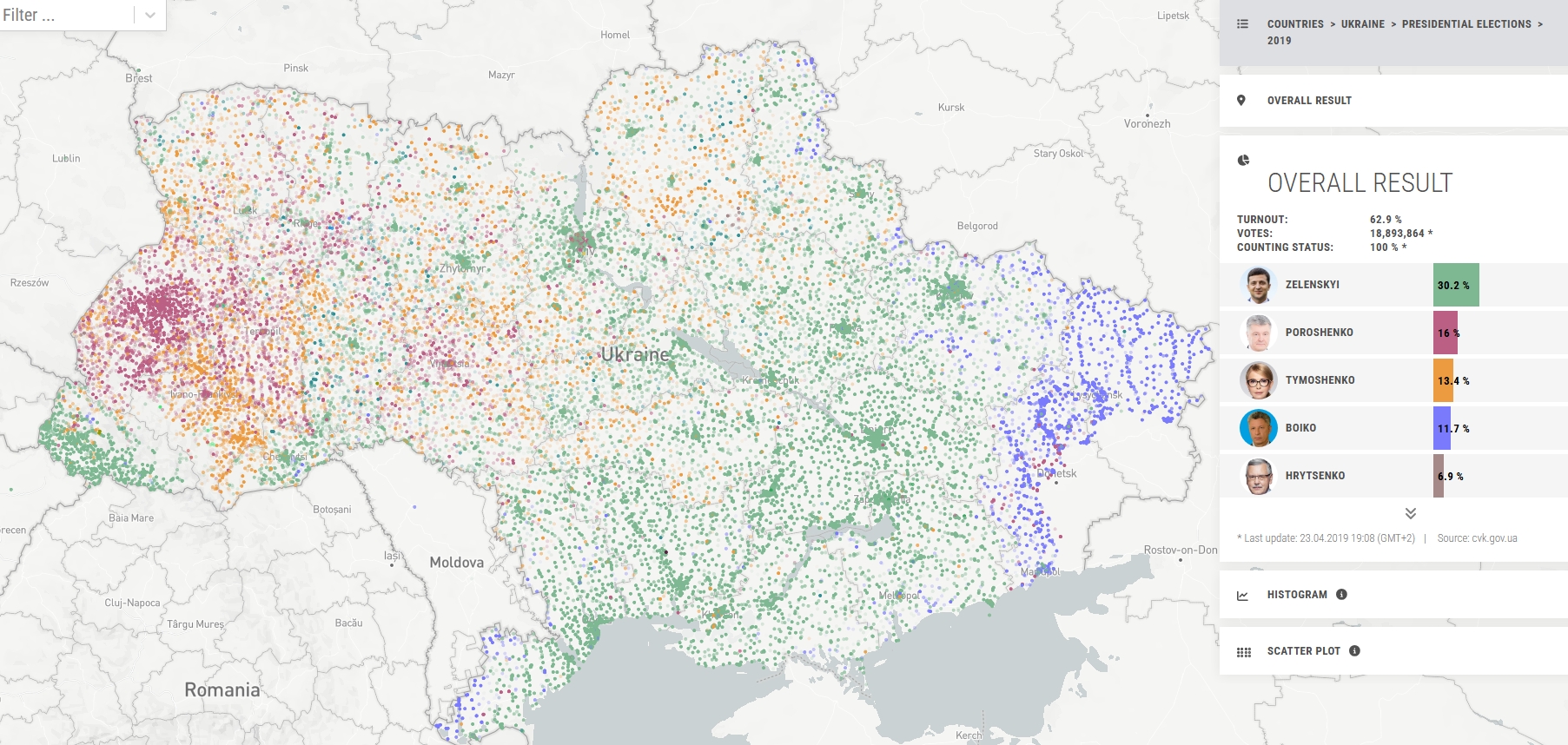
It is worth mentioning that despite all its economic and other problems, independent Ukraine did, unlike Russia and Belarus, succeed in establishing a political system featuring regular changes of government and competitive elections. Ukraine has held seven presidential elections since December 1991, and six different people have taken up the office in that period. By way of comparison: in Belarus, the office of president was held by one person in the 1994–2024 period and three people served as president over that period in Russia.
Despite its economic and other problems, independent Ukraine did, unlike Russia and Belarus, succeed in establishing a political system featuring regular changes of government and competitive elections.
No blood was spilled in connection with Ukraine’s separation from the USSR in December 1991. Nor was physical violence a significant factor in the subsequent political development of independent Ukraine. This changed 2014, first with the Euromaidan in January and then with Russia’s annexation of Crimea in March and the outbreak of the war in the Donbas in April.
Russia’s full-scale invasion on 24 February 2022 and the ability of Ukrainian society to defend itself against it have led many observers to describe the current Russia-Ukraine war as a war over the political and cultural independence of Ukraine.
Translating journalism
between culture, politics and aesthetics
This article first appeared in German in a Gnose series about Ukraine in cooperation with the Centre for East European and International Studies (ZOiS).
- Iulian Bachynsʹkyi, 1924. Ukraïna irredenta. Berlin: Vydavnytstvo ukraïnsʹkoï molodi. ↩︎
- Dmytro Doncov, 1926. Natsionalizm. Lʹviv: Nove žyttia. ↩︎
- Ivan Mikloš, 2015. Quo vadis, Ukraine? Is there a chance for success? (Quo vadis Ukraino? Czy istnieje szansa na sukces?), mBank – CASE Seminar Proceedings 139, CASE – Center for Social and Economic Research. ↩︎