
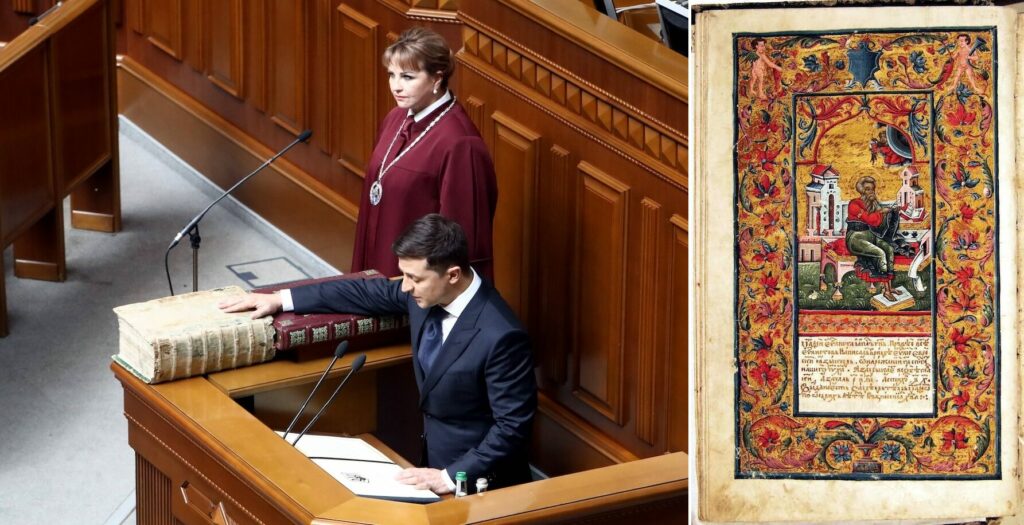
The Ukrainian language is spoken by roughly 40 to 45 million people and is therefore not one of the world’s “small” languages. Nonetheless, people often ask whether it is really a language in its own right at all. Isn’t it “pretty much the same as Russian” or “a dialect of Russian”?
No, it is not, writes linguist Michael Moser in his Gnose on the modern Ukrainian language. The second piece of our new dossier in English: Ukraine Basics.
Chapters
Mutually understandable?
That Ukrainian and Russian are related is undisputed. However, the closeness of this relationship is often greatly exaggerated. Most Ukrainian speakers understand Russian extremely well, and there is a simple reason for this: they learned it. Russian speakers can understand individual Ukrainian words, but overall, inherent mutual intelligibility is limited to elements of an expanded basic vocabulary – which is the same thing that can be said of other Slavic languages. If someone speaks slowly and clearly about wanting to drink a glass of water or to sleep, it works.
Beyond that, things get harder. From that point on, Polish speakers often understand Ukrainian speakers better than Russian speakers do. And that goes double for speakers of Belarusian: as recently as the 19th century, many Ukrainians considered Belarusian to be a variety of their own language.
Confusing language names
The doubts about whether Ukrainian is a distinct language have been fuelled, to no small degree, by some of the names used to refer to it in the past, above all Little Russian. This term emerged towards the end of the 17th century, when the contact between Ukrainians and Russians first began to intensify.
Originally, the term was not meant to be in any way derogatory; on the contrary, the Little Russian elite played a leading role in the culture of the Tsarist Empire. The main reason for the introduction of the glottonym Little Russian was that the differences between it and “Great Russian” were so extensive as to make it seem necessary to have different names for the two languages. Until then, all the varieties had been referred to simply as “Rusian” or “Russian”. The “Rus-” in the name of these languages refers to Medieval Rus, which was broken up in 1240, but there is no evidence that the name is that old.
Its first attested use is in the 1260s, when it appears in the Galician-Volhynian Chronicle, whose origins lie very far from Russia. Until then, one spoke only of the “Slavic language”. “Rus(s)ian” as a designation used to identify a language, however, did not originally refer to a Slavic language at all but to the Scandinavian language spoken by the ruling dynasty of Rus, the Rurikids, who had originally come from what is now Sweden.
Old commonalities and differences
There was never one single, uniform “Old Russian” language, although most of the Slavic dialects spoken in the territories of Rus were quite similar. The differences between the dialects of Kyiv and Novgorod – the two most significant Rus′an cultural centres – were quite substantial though. The dialect spoken in Kyiv became the basis for the development of the secular written language; for religious writing, the liturgical and literary language of Church Slavonic filled this role. The latter was created in around 863 by Cyrill and Methodius, the “Slavic apostles” from Thessaloniki, and imported to Rus along with Christianity ca. 988.
Following the collapse of Medieval Rus, the differences between the language varieties grew more pronounced. The Muscovites, forced to accept the supremacy of the Mongol Empire, closed themselves off from Western influences, continuing to do so even long after they freed themselves from Mongol rule in the late 15th century. The formerly Rus territories in the present-day states of Belarus and Ukraine were incorporated into the Grand Duchy of Lithuania and the Kingdom of Poland (the territories south of the Carpathians settled in part by groups from Rus were already subject to the Hungarian crown at the time and remained so).
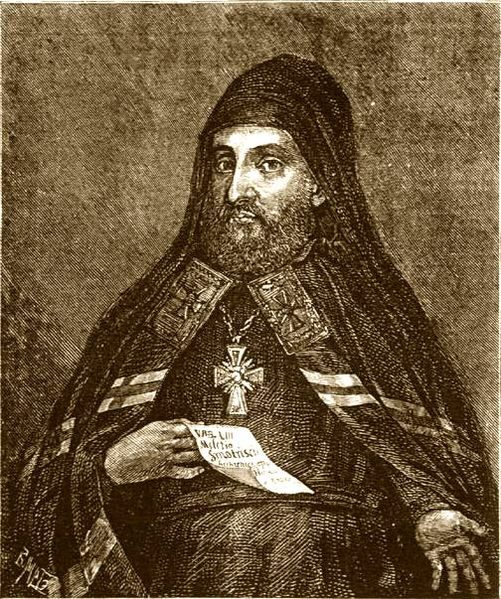
In the early modern period, the “Ruthenian” language culture (the language was still referred to as russkiy yazyk by its speakers), which Ukrainians and Belarussians largely shared, was strongly influenced by contacts with the West. Ruthenian actually served as an official language in the Great Duchy of Lithuania. It was increasingly elaborated and normalized, and later even developed into a literary language. In the Tsarist Empire, only Church Slavonic functioned as a standard language, and there were no ambitions to create a literary language based on vernacular varieties or the language of administration.
In addition to their own local dialects, Ruthenian elites of the early modern period were fully proficient in the Ruthenian literary language and in Polish, Church Slavonic and Latin, many had mastered Greek as well and some had Hebrew. They were not proficient in Russian. Representatives of the Ruthenian elite did not acquire their educations solely in their own Orthodox schools: many of them studied at universities in Poland or Western Europe. All of this left traces on the Ruthenian language: the secular literary language was strongly based on Polish in many respects, and there are unmistakable signs that the European language cultures served as stylistic models. The clergy of the Tsarist Empire never enjoyed educational opportunities of the kind described above.
Russification and linguistic revival
As previously mentioned, the Little Russian and “Great Russian” languages did not come into intensive contact with one another until after the Cossack Uprising led by Bohdan Khmelnytsky (1648–1654), which led to the incorporation of the Ukrainian territories on the left bank of the Dnipro and the city of Kyiv into the Tsarist Empire, albeit initially on a basis of Cossack autonomy. The Ruthenian elites, who took up high offices in the Church leadership, produced the Russian Baroque religious literature, basing it on Church Slavonic. Ruthenian written culture, though, entered a decline in the later years of the 17th century, both in and outside of the Tsarist Empire. During the period of Cossack autonomy, Ruthenian administrative-language traditions initially continued to develop, but they lost all influence in the 18th century as Russian gradually became the language of administration.
As Russian expansion swallowed up more territories, these processes continued, including in the territories on the right back of the river that were incorporated into the Tsarist Empire after the partitions of the Polish-Lithuanian Commonwealth. This was not the case in Galicia and Bukovina, which was acquired by the Habsburg Empire, or in the Transcarpathian territories, which remained under the Hungarian crown. In these regions, the Ruthenian literary language was able to survive in hymns and catechisms, sometimes even in sermons, until a language revival movement sprouted in Galicia and began to spread from there.
During the period of Cossack autonomy, Ruthenian administrative-language traditions initially continued to develop, but they lost all influence in the 18th century as Russian gradually became the language of administration.
In the 18th century, language varieties with a strongly vernacular character were confined to the spheres of the “low style”, and this applies both to Ukrainian and Russian. This changed with the emergence of the national movements and Romanticism in the “long” 19th century. True to the spirit of Romanticism, Ukrainians looked primarily to their widely treasured folk songs when elaborating their new literary language. This project reached a first high point in the work of Taras Shevchenko, whose poetry collection Kobzar set off a furore when it was published in 1840. A former serf and victim of the Russian Empire (he was exiled as a dissident and forbidden to write or paint), the Academy painter and national poet Shevchenko became an enduring symbol of Ukraine. Though Shevchenko himself rarely used the term, it was during, and just after, his lifetime that the “Ukrainian” established itself as the name for this language.
Imperial language bans
The renewal of the Ukrainian language in the Russian Empire did not begin to spread beyond the sphere of literary works until after Russia’s defeat in the Crimean War (1853–1856), when Ukrainians created the foundations for a Ukrainian-language press and printed school textbooks and adult education textbooks for use in privately operated Sunday schools. A translation of the Bible was also completed by Pylyp Morachevsky.
The Russian Empire responded to this with repression. In 1863, the tsar’s interior minister Petr Valuev issued the notorious decree known as the Valuev Circular. This document claims that “most Little Russians” were of the opinion that Ukrainian was simply “the Russian language, merely corrupted by the influence of Poland” and that a distinct “Little Russian” language “did not, does not and cannot exist”1. The bans laid down in the circular significantly restricted the use of this allegedly non-existent language, and its standardisation was prevented.
Then, in 1876, Tsar Alexander II issued the decree known as the Ems Ukase which de facto banned the Ukrainian language from public life completely. After that, Ukrainian was increasingly denigrated as a “peasant language”, conveniently ignoring the fact that Russian played this same role to quite a large extent. However, standard Russian, a variety strongly influenced by the elites, did spread, particularly in Ukraine’s larger cities, and sometimes at the expense of other languages, such as Yiddish. Meanwhile, mixed language forms were also taking shape. These varieties, combining elements of both Ukrainian and Russian, would later come to be known as Surzhyk.
Establishment of the standard language
Despite all the obstacles, Ukrainian was developed into a modern standard language. This achievement is due in part to the fact that intellectuals in the Russian Empire continued to exploit any chance to do so – such as the liberalization following Russia’s defeat in the Russo-Japanese War and the easing of language bans in 1905 (only bans that applied to literature and the press). Another factor was that they were able to work with “Ruthenians” in the Habsburg Empire who took advantage of the more favourable language-policy environment there to extensively elaborate their Ruthenian language, which enjoyed official recognition as a “language of the crown land” in Galicia and Bukovina. As a result, Ruthenian met the key criteria for a modern standard language there by 1895: it had been codified in grammar books and dictionaries and was used in a diverse educational system, in science and public administration, in the press, etc.
Intentionality plays a particularly clear role in the development of Russian, whose standardisation had begun – with difficulty – only in the 18th century.
Confronted with these facts, the anti-Ukrainian language camp even today responds by claiming that Ukrainian was created “artificially”. They often follow this up with the absurd notion that some other group was responsible for this: the Austrians or the Poles, even the Germans, in a pinch. Yet all standard languages are the product of deliberate action and, in that sense, artificial, including Russian. In fact, intentionality plays a particularly clear role in the development of Russian, whose standardisation had begun – with difficulty – only in the 18th century.
Ukrainian People’s Republic and Soviet Ukraine
The progress made in elaborating the language in Galicia provided a foundation for similar efforts in central and eastern Ukraine in the initial years after the First World War, when Ukraine enjoyed autonomy and a temporary sovereignty. The Bolsheviks were unable to ignore the developments in the Ukrainian People’s Republic, so significant progress in the standardisation of Ukrainian was achieved in Soviet Ukraine of the 1920s and early 1930s as well. Beginning in 1933, though, Stalin’s mass terror put a stop to the “Ukrainisation” (incidentally, when was Russia “Russified”?) and the policies that allowed it. The subsequent waves of Russification continued into the late phase of Soviet rule.
Although Ukrainian was officially tolerated and even pro forma promoted, for instance at the institutes for Ukrainian philology, the language was henceforth underrepresented in public life (outside of western Ukraine, which did not become part of the Soviet Union until the end of the Second World War). Anyone who used standard Ukrainian outside of one of the prescribed scenarios was considered a “bourgeois nationalist” and became a target of repression. Those who used dialects or mixed forms combining Ukrainian with the dominant Russian language were dismissed as uneducated. For these reasons, Ukrainian-speakers newly arriving in urban areas, and above all in the larger cities, switched to Russian in droves. The consequences can still be felt today: Russian is the dominant language in many of the major cities, whereas Ukrainian holds far greater sway in the countryside surrounding them.
Ukrainian in Ukraine
Nonetheless, the Ukrainian language is still very much alive: Ukraine’s most recent (2001) national census showed that 67.5 percent of the population identified Ukrainian as their ridna mova (roughly equivalent to “native language”), 29.6 percent named Russian. Later surveys show a clear shift towards Ukrainian.
Language policy measures played a significant role in promoting the Ukrainian language. In 1989, and thus before the collapse of the Soviet Union in 1991, Ukrainian was declared to be the sole state language of what was then still the Ukrainian Soviet Socialist Republic; a status confirmed in the Constitution of Ukraine adopted in1996. However, all Ukraine’s national laws as well as in international treaties protect all the other languages in Ukraine as well though – including Russian.
In 2022 only seven percent of the population believed that the Russian language should be granted the status of a second state language.
Clearly, language laws alone are not responsible for the increase in the use of Ukrainian since 1991: new linguistic allegiances play a role as well. The pace of this change has quickened in recent years, primarily due to Russia’s full-scale war of aggression against Ukraine. As recently as 20122, around 40 percent of the population still reported speaking only Russian at home; by 2021, that figure had fallen to 26 percent; in 2022 it was 18 percent. Only seven percent of the population believed that the Russian language should be granted the status of a second state language in 2022; 83 percent were in favour of keeping Ukrainian’s status as the only official state language.
Thus, the Ukrainian language will continue to evolve. It is simply irrepressible.
This article first appeared in German in a Gnose series about Ukraine in cooperation with the Centre for East European and International Studies (ZOiS).
Further reading:
Moser, Michael: New Contributions to the History of the Ukrainian Language. Edmonton – Toronto: Canadian Institute of Ukrainian Studies Press, 2016. 667 pp.
Vakulenko, Serhii: The ideological and pragmatic framework of the history of modern Ukrainian. In U. Schmid & O. Myshlovska (Eds.), Regionalism without regions: Reconceptualizing Ukraine’s heterogeneity, Budapest: CEU Press, 2019, pp. 135–156.
- Zirkular des russländischen Innenministers Petr A. Valuev, St. Petersburg, 18. Juli 1863 https://historia-universalis.fm/wp-content/uploads/2022/05/Quelle_Valuev-Zirkular.pdf ↩︎
- Belei L., Rovniak O.: Zmina movnoï povedinky ukraïntsiv unaslidok povnomasshtabnoho vtorhnennia Rosiï v Ukraïnu. Movoznavstvo. 2023. № 5. pp. 3–39. ↩︎