Voter preferences and political moods in Ukraine have always been firmly focussed on personalities. Ideologies and party platforms do not excite much interest. Extreme fluctuation in polling numbers is one result of this.
Acceptance of Zelensky as the war president is widespread within the Ukrainian population. But there are a few figures out there who could certainly give the current head of state a run for his money should it become possible to hold elections in Ukraine again one day – currently, the constant, extremely heavy Russian aerial attacks and the Russian occupation in eastern part of the country make elections impossible. There is also a possibility that some distant postwar period will see a rise in popularity of more extremist political forces.
Ukrainian journalist Denis Trubetskoy decodes the political workings of Ukraine and the changes in the political moods and voters’ interests brought by the war. The third piece of our new dossier in English: Ukraine Basics.
Historically, Ukraine has been a country of constant political change. This is evident in the fact that its voters have only once re-elected a president to a second term (Leonid Kuchma) but in other ways too. It is also something of a political tradition in Ukraine for new presidents to see a disastrous plunge in their approval ratings about six months after taking office – regardless, usually, of whether or not they are doing a good job.
However with martial law in place since February of 2022, Volodymyr Zelensky has been governing Ukraine since May 2019. In the early parliamentary elections he called that same year, Zelensky’s party Sluha Narodu (“Servant of the People”) – a swiftly coalescing party that had appeared on the scene practically out of the blue – won an absolute majority in the Verkhovna Rada (Ukraine’s parliament). Although that majority has de facto long since eroded away, the president usually has no difficulty coming up with around 260 votes with the help of other parliamentary groups. He needs 226 votes to pass legislation.
The war presidency – an unnatural state
Thus Ukraine – a semi-presidential republic with strong powers vested in its parliament and cabinet, and one in which the president’s area of authority is, strictly speaking, limited to the domain of foreign and defence policy – finds itself in an unnatural state. It is true that heads of state in Ukraine have always wielded powers beyond those enumerated in the Constitution. But Ukraine’s politics has generally been characterised by extremely complex parliamentary majorities and hard compromises, a trait particularly pronounced in the periods after the 2004 Orange Revolution and the 2013/2014 Maidan Revolution.
The situation Ukraine currently finds itself in is unprecedented: the president has been governing quasi on his own for over seven years and has been doing so with strengthened authorities under martial law since 2022. This is also a situation that is very unlikely to be repeated once the Russia-Ukraine war has ended. As recently as the winter of 2021/2022, before Russia’s large-scale invasion that February, Zelensky appeared to be sliding into a political abyss. There was media war being waged at the time between the president and Rinat Akhmetov, and Zelensky’s chances for emerging victorious did not look good. In those days, Akhmetov, probably the most powerful man in Ukraine, controlled a vast media empire, and he was backing Dmytro Razumkov, who had been Zelensky’s campaign strategist and subsequently served as the chairman of the Verkhovna Rada. Razumkov embodied everything that a large percentage of the voters wanted: a Western-oriented and liberal alternative to the patriotic agenda of the previous president, Petro Poroshenko, the core of which was summed up by his campaign slogan “Army! Language! Faith!”. Zelensky had stuck to that same agenda since taking office in 2019. He did so because he had no other alternative in the face of Russian aggression, but it had left many voters visibly disappointed.
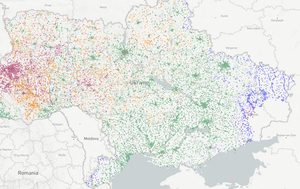
Presidential Elections
in Ukraine 2019
The events of 24 February 2022 turned this situation on its head. Zelensky found the right words to say to the people of his country and came across well in the Western media. In the first months of the war, his public trust ratings sometimes topped 90 percent. Clearly, the basic situation is different today, four and a half years later. Yet despite numerous corruption scandals and his strategically dubious reshuffles within his inner circle, a public opinion survey carried out in late August/early September by the widely respected Kyiv International Institute of Sociology (KIIS) found that 54 percent of Ukrainians still trust Zelensky – a huge percentage, particularly considering the typical Ukrainian political dynamics. Although it falls short of the roughly 60 percent ratings that Zelensky continued to poll long after the initial semi-taboo fell away and public, and at times harsh criticism of his administration began to be heard, 54 percent can still be considered a very good number, especially in view of the frequent chaos that characterises the country’s political tradition.
It would hardly be possible to overestimate the importance of the fact that the president continues to enjoy a relatively high level of trust. Even though Zelensky does not always do everything necessary to reinforce this trust.
Setting aside any assessment of Zelensky’s presidency and questionable interior and personnel policy, this high level of trust is good news for Ukraine as a whole. Every six months or so, a new debate flares up on the question of whether it might not be possible to find a way to hold elections under the current wartime conditions after all. This is to be expected, but debates of this kind soon founder in their own irrelevance (as illustrated by the failure of the latest call for elections by the ousted defence minister, Mykhailo Fedorov) due to the complex security situation (even well behind the front lines), which the increasing ballistic threat from Russia and the constant deployment of “reactive” jet-powered drones have only made worse. It would hardly be possible to overestimate the importance of the fact that the president – including in his role as Supreme Commander in Chief – continues to enjoy a relatively high level of trust. Even though Zelensky does not always do everything that he should to reinforce this trust.
Nonetheless, there is a strong desire among Ukrainians for change in the country’s structures of government. This explains why surveys show a decrease in the percentage of the population that opposes the idea of holding elections during the war, though this remains the majority view. The desire for change is mainly directed towards the Verkhovna Rada, which, if one looks only at its record over the past few years, scarcely qualifies to be considered a political subject at all. It is becoming clear that the public, while accepting Zelensky as their war president, wants someone else to be president once the fighting is over. In a KIIS survey conducted in April 2026, only 28 percent of Ukrainians said Zelensky should remain in office after the war. In another KIIS survey asking a slightly different question in early June, 67 percent of respondents indicated that they expected a change in presidents after the war.
The potential competition: Zaluzhnyi, Budanov, Federov
This list of favourites for what, for the time being, remains a purely hypothetical presidential election also tells us a great deal about how politics has traditionally worked in Ukraine. When the war started, leading sociologists in Ukraine made an informal agreement not to publish the results of hypothetical election polling. They have not all abided by this agreement though. By compiling the results of published and non-published surveys carried out by reputable polling organisations (it is possible to get a look at these in the back rooms of political Kyiv), one can obtain a rough picture of Ukrainian voters’ current preferences.
Until recently, Volodymyr Zelensky came out in front in almost every survey about a first round of a hypothetical presidential election. However, the polling data also indicated that Zelensky’s situation is similar to that of his predecessor, Petro Poroshenko, who made it into the runoff election only to suffer a resounding and unequivocal defeat there.
Zelensky’s two biggest competitors are now Valerii Zaluzhnyi, who was the commander in chief of the Ukrainian Armed Forces for the first two years of the full-scale war and is now Ukraine’s ambassador in London, and Kyrylo Budanov, a former head of the HUR (Ukraine’s military intelligence service) who has been Zelensky’s chief of staff since January 2026. Zelensky’s chances in a runoff election against either of them would be slim to none.
In July 2026, Mykhailo Fedorov, a long-time of confidante of Volodymyr Zelensky, suddenly sprang to third place in the results for the question about a hypothetical presidential election. This happened amid the protests against Fedorov’s surprise dismissal as defence minister just six months after he had taken office. Had the final round of a presidential election had been held that summer, Fedorov, too, would have stood a good chance of defeating his “political mentor”. The situation has since changed due to some unsuccessful manoeuvring on Fedorov’s part, but he would still have to be taken seriously as a candidate.
First in war, first in peace?
Among other things, the list of potential contenders testifies to a great desire on the part of Ukrainians for the involvement of the country’s war heroes in politics. Both Zaluzhnyi, the general who comes across as unpretentious and approachable and continually enjoys a greater level of trust than other politically relevant public figures, and Budanov, the master of special operations, are seen as trustworthy military legends in Ukraine, although the latter’s image could suffer as a result of his alleged involvement in recent corruption scandals.
Very little is known about the political attitudes of Ukraine’s population, and this, too, is typical of the country, in wartime or not. Strictly speaking, it is not entirely clear what Zelensky’s own political views are either, even now, in the eighth year of his presidency. After its founding, his Servant of the Nation party primarily sought to position itself as libertarian, but it is not clear whether all the MPs in the presidential caucus even remember that anymore.
Despite the country’s long historical parliamentary tradition, politics in Ukraine is strongly personality driven. Concrete ideas and ideologies play a subsidiary role. This is reflected in today’s Verkhovna Rada. It would be a mistake to reduce the opposition parties of President Petro Poroshenko (European Solidary) or of former Prime Minister Yulia Tymoshenko (Batkivshchyna/Fatherland) to their leader alone: Poroshenko’s party is primarily of a nationalist-liberal character and Tymoshenko’s is similar to the Republican Party in the USA in many respects. However, it is nearly impossible to imagine either of them without their leader. The fact that recent polls put a non-existent party associated with former Commander in Chief Zaluzhnyi in first place in a hypothetical parliamentary election is also symptomatic of this focus on individuals.
That the expectations placed on key individuals are excessively high also partly explains the startling speed with which the level of trust drops as soon as an individual fails to meet those expectations in full.
This phenomenon plays a substantial role in the traditional plunge in presidential approval ratings about 6 months into their term, and it was also at work in the period after the bumper election year of 2014, in which numerous heroes of the Maidan Revolution or the original Donbas war won seats in the Verkhovna Rada. That the expectations placed on key individuals are excessively high also partly explains the startling speed with which the level of trust drops as soon as an individual fails to meet those expectations in full.
This is a risk that a Zaluzhnyi or a similar candidate will have to take clearly into account, because in the period after a (hypothetical) cease fire, Ukraine will face enormous problems, on a scale substantially greater than that of those the country confronted in 2014. Thus far, the main concern of the former army chief has been to get through the period until the next election without being tarred by scandal. So far, Zaluzhnyi, who has been largely out of the media spotlight in London for the past two years but has nonetheless been acting in a deliberately statesmanlike manner, has succeeded in this. And in fact, there is not a lot to be until there is a realistic prospect of an election anyway, whereas one can still lose quite a lot of political capital, as Fedorov has recently made clear.
The future will be determined by the outcome of the war
Nonetheless, political developments in Ukraine after the war ends or during a ceasefire will also depend on some factors that are less closely linked with individuals. The issue of the army’s involvement in politics, for instance, is not confined to Zaluzhnyi or Budanov. One should also expect to see a rise in the popularity of the originally extreme-right, now for the most part more moderate right-wind conservative ideas linked with what was originally a volunteer militia unit called the Azov Battalion, whose current successors, the Special Forces Brigade “Asov” (part of the National Guard) and the Third Army Corps, have shown themselves to be extremely effective in the full-scale war. Andriy Biletsky, for example, the Third Army Corp’s commander, has made no secret of his political ambitions, even though his successes on the Donbas front have made him one of Volodymyr Zelensky’s favourite generals.
One of the most surprising developments in the last years, the alliance between the current president and the man who once founded the right-wing National Corps party is unlikely to survive in the period after the war. This is because it is not, in fact, really about Biletsky as an individual. But a part of the country’s postwar political landscape may well be shaped to a substantial degree by the issue of immigration – which Ukraine will undoubtedly need for its reconstruction. That a majority of Ukrainian voters would support decidedly radical right-wing policies is very difficult to imagine, although it is true that the current political mainstream, liberal though it is, is strongly focused on national identity.
A part of the country’s postwar political landscape may well be shaped to a substantial degree by the issue of immigration – which Ukraine will undoubtedly need for its reconstruction.
Another aspect is this: openly pro-Russian policy has been unthinkable in Ukraine since 24 February 2022. As what feels like an endless war grinds on, though, and the wounds it inflicts multiply, the number of people who, deep down, would be willing to agree to a peace at almost any cost is gradually increasing. While this is definitely not the position of a majority of the pubic, the extreme sensitivity of the issue makes it impossible to measure just how much support it does have, despite the excellence of the Ukraine’s leading polling organisations. However large or small this segment of the population may be, it exists, and populist politicians – such as Oleksiy Honcharenko, who is technically a member of Poroshenko’s party but has been behaving more like an independent – have been trying to ride this wave for a while now, making rhetorical hay out of the difficult issues of mobilization.
The primary risk in this respect does not actually concern the next election but the voting that follows it. One must assume that Ukraine is unlikely to obtain very serious security guarantees after a ceasefire and that its economy will be in a precarious position. Added to the mix is a certain degree of disappointment with the West, which has been on the rise since the US under Trump stopped supplying direct aid to Ukraine. It may come as a surprise to many observers abroad and perhaps even to some inside Ukraine, but there would be several factors that might play into the hands of a party like Georgian Dream in Georgia – which is to say a political force that, while clearly labelling Russia as the aggressor, might play with the argument that a pragmatic policy could prevent the war from starting up a third time.
It is no secret in political Kyiv that the president has long since had his sights on a second term. In the end though, his candidacy, too …will be largely determined by the outcome of the war.
Whatever happens, the political landscape of a future Ukraine will depend on the concrete conditions under which the current phase of the war ends. At this point, no one can say what these might be – and the hoped-for cease fire that would freeze the front lines as they are lies in the distant future. By the same token, it is also completely unclear whether a Zaluzhnyi, a Budanov or a Zelensky would be able to run for office at all.
As for the current president: when Zelensky entered office, he did so with the clearly stated intention of serving only a single term, but he has made statements to the contrary more than once in the past years. It is no secret in political Kyiv that the president has long since had his sights on a second term. At the end of the day, his candidacy, too, will depend on how realistic his chances appear to be – and that will be largely determined by the outcome of the war.